
This post may contain referral/affiliate links. If you buy something, we may earn a commission. Read the full disclosure.
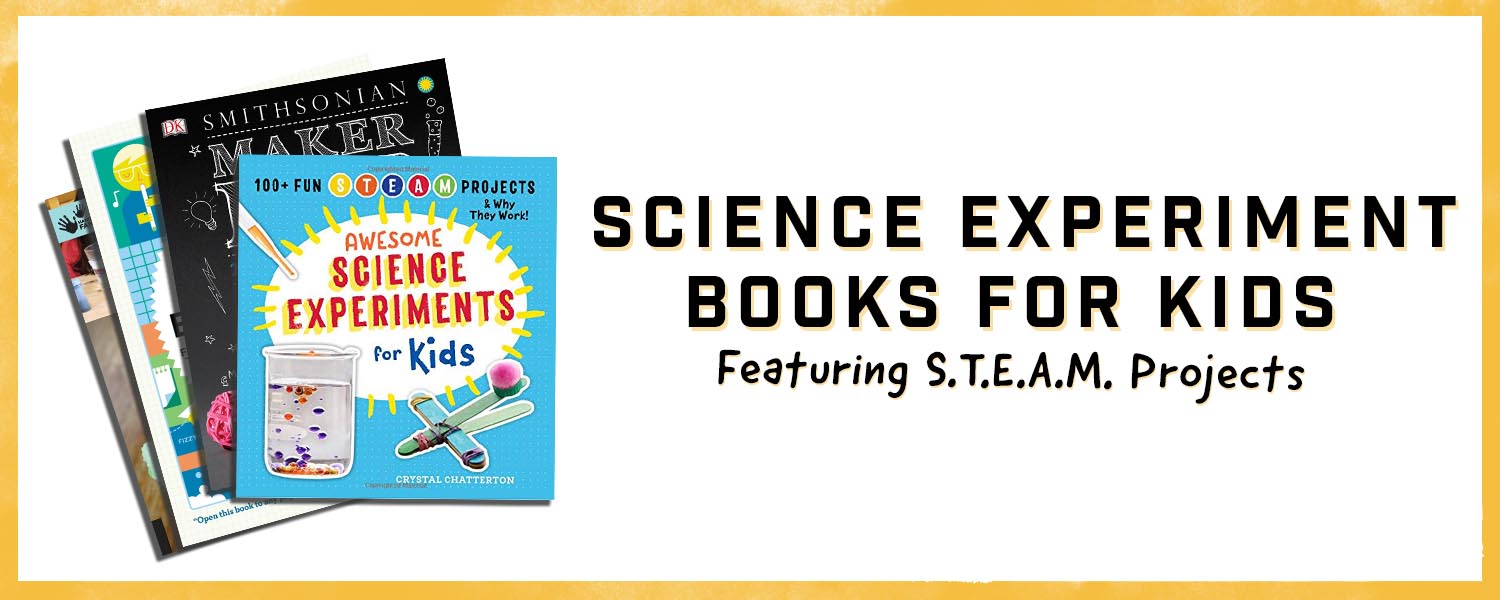
If you’re looking for the best science experiment books for kids, then you have come to the right place! In this article, we share our favorite hands-on science experiment books for kids. How did we come up with this list? We looked for science experiment books that share relatively accessible experiments, or in other words, experiments that use common items found at home, can easily be purchased at a hardware or hobby shop, or with elements found in our backyards.
This experiment book list is designed to be a quick resource guide for parents, family, or friends who want to compare science experiment books for children. For each book, we share an image of its cover along with a peek at what lies inside. We also share the age range we recommend for the book, the author, the books dimensions, page count, and book type and publication date, as well as a quick summary of the experiment book and a link to view it’s price online. Some titles also have related books by the same author or made in a similar format. We included these as well in case they peek your interest.
Note: After we share our favorite science experiment books, read on to learn why it’s important to incorporate science, technology, engineering, the arts, and mathematics into your routine to make sure your little ones are getting exposed to all of the different ways to learn and create!

A Little Bit of Dirt: 55+ Science and Art Activities to Reconnect Children with Nature
Age Range: For children ages 4-8 years old.
Author and Photographer: Asia Citro
Book Dimensions: 7 x 0.5 x 9.2 inches
Page Count: 128 pages
Book Type and Publication Date: Paperback – March 22, 2016
A Little Bit of Dirt Book Summary: Expect to be outside making things with nature with help from this book, including the following projects: Dandelion Bubbles, Rain Drums, Seed Bomb Lollipops, and more! We like this book in part because it shows high-quality photos of actual children completing the projects, with full, step-by-step instructions and a total of over 55 different project ideas, all perfect to do outside and in nature.


Similar Books by the Same Author: Asia also has the following books, which are definitely worth checking out, especially if you like the sound of this one! The Curious Kid’s Science Book and 150+ Screen-Free Activities For Kids.

Big Science for Little People: 52 Activities to Help You & Your Child Discover the Wonders of Science (An Official Geek Mama Guide)
Age Range: For children ages 4-8 years old.
Author: Lynn Brunelle
Book Dimensions: 5.6 x 0.4 x 7.5 inches
Page Count: 144 pages
Book Type and Publication Date: Paperback – September 20, 2016
Big Science for Little People Book Summary: This book introduces little ones to the physics and chemistry, biology and ecology behind
*Side note: unlike the other books included on this list, this book is not for visual learners since it’s mainly just text information and directions.
Fun Fact: Lynn Brunelle is a four-time Emmy Award-winning writer for Bill Nye the Science Guy!

Awesome Science Experiments for Kids: 100+ Fun STEM / STEAM Projects and Why They Work
Age Range: For children ages 5-10 years old.
Author: Crystal Chatterton
Book Dimensions: 8.4 x 0.9 x 8.9 inches
Page Count: 254 pages
Book Type and Publication Date: Paperback – February 13, 2018
Awesome Science Experiments for Kids Book Summary: This children’s book includes over 100 science experiments that apply the scientific method. Along with step by step instructions and lots of high-quality photos, this book also includes the hows and whys behind these experiments.


Similar Books by the Same Author: Awesome Physics Experiments for Kids and Awesome Engineering Activities for Kids.

Kitchen Science Lab for Kids (Lab Series)
Age Range: For children ages 7-10 years old.
Author: Liz Lee
Book Dimensions: 8.4 x 8.5 x 0.7 inches.
Page Count: 144 pages
Book Type and Publication Date: Flexibound – August 14, 2014
Kitchen Science Lab for Kids (Lab Series) Summary: This science lab book utilizes items found at home in the kitchen to create 52 experiments that introduce little ones to scientific principles in a fun, accessible way. In this book, you will explore the science of crystals, solar energy, acidification, and static energy.


Similar Books by the Same Author: Liz Lee Heinecke is a mother and scientist. She also wrote two other science experiment books for kids: STEAM Labs for Kids and Outdoor Science Lab for Kids.

Maker Lab: 28 Super Cool Projects
Age Range: For children ages 8-12 years old.
Author: Jack Challoner, Foreword by Jack Andraka
Book Dimensions: 8.8 x 0.7 x 11.1 inches
Page Count: 160 pages
Book Type and Publication Date: Hardcover – July 5, 2016
Smithsonian Maker Lab Book Summary: Requiring only household materials, children ages 8-12 can complete 28 different projects and crafts to get their creative wheels turning. Each project has a difficulty rating and an estimated timeframe for the project.


Similar Books by the Same Author: Smithsonian has two other books in their Maker Lab collection, Maker Lab Outdoors
What is the difference between S.T.E.A.M. and S.T.E.M.?
The short answer is this: S.T.E.A.M. stands for Science, Technology, Engineering, Arts, and Mathematics. S.T.E.M. is the same, minus the Arts. Sometimes, these acronyms are used interchangeably, however, they are different, in that one includes the Arts by fostering creativity and innovation and the other does not.
According to EducationCloset, a support program for STEAM learning, “STEAM is an educational approach to learning that uses Science, Technology, Engineering, the Arts and Mathematics as access points for guiding student inquiry, dialogue, and critical thinking.”
The Importance of S.T.E.A.M. Activities
Children everywhere are notoriously curious. We naturally want to find out how things work. That’s why it’s important to incorporate STEAM activities into the lives of children and expose them to science, technology, engineering, the arts, and mathematics. Not to mention, it’s fun! Completing unique projects with little one’s is a great way to spend quality time with them while helping them learn while being creative and making things together.
Science – Encouraging curiosity through experiments and exploration helps children develop problem-solving skills and how to investigate concepts they might not know or understand.
Technology – Sharing how to use technology and tools, like microscopes, binoculars, computers, and other items help children learn how to use the right tools for the task at hand.
Engineering – Teaches children to ask why and how to learn how things function in order to design and build things and create solutions.
Art – Develops creativity, self expression, and the power to make something from their imagination.
Mathematics – Teaches children how to look for patterns, problem solve, deductive and inductive reasoning, and more.
Science Experiment Books VS Science Experiment Kits
Overall, we have found that buying a science experiment book instead of a premade kit has much more value and long term use. Most kits available for purchase online or in store come with unnecessary plastic pieces that really just seem like filler… The truth is, most items needed to perform science experiments with kids are items that most people already have around their house. That’s why we share experiment books rather than kits. The one major exception I make to this statement is shared below: Kiwi Co, a S.T.E.A.M. Subscription box for kids that come with the materials and gear needed to make some truly unique and thought provoking things like making a functioning claw grabber like you might see at a carnival, or designing wearable, felt bird wings to attach to your arms, even building a functioning wooden catapult. Read on to learn more about Kiwi Co crates for kids and get a coupon below.

Kiwi Co S.T.E.A.M. Kits for Kids of All Age Groups
Kiwi Co is a subscription box that shares a variety of different discovery boxes centered around science, technology, engineering, art, and math projects for kids ages 0-16+. Unlike other STEAM kits for kids, Kiwi Co discovery boxes aren’t filled with one-time use plastic junk, but more thoughtful kits, many of which use paper, wood, and other organic materials.
Kiwi Co Subscriptions Make Great Gifts!
These subscription boxes make great gifts since you can ship the first box to yourself, wrap it and bring it to the party, then schedule the next boxes (you choose the length) directly to the lucky little one’s home! This is also a great gift to get for kids you have to ship your gifts to.
Below are the different lines Kiwi Co offers:
- Tadpole Crate: For little ones ages 0-36 months.
Includes kits for exploration and discovery. - Koala Crate: For toddlers ages 3-4 years old.
Includes kits for playing and learning. - Kiwi Crate: For children ages 5-8 years old.
Includes kits featuring science, art, and more. - Atlas Crate: For children ages 6-11 years old.
Includes kits featuring geography and culture.
- Doodle Crate: For children ages 9-16 years old.
Includes kits that feature art and design. - Tinker Crate: For children ages 9-16 years old.
Includes kits that feature science and engineering. - Eureka Crate: For children and adults ages 14+.
Includes kits that feature engineering and design.

In closing, a Science Experiment book is a great item to buy for children when you plan to spend time and plan activities with the child you are gifting. We think this books would make fantastic gifts from aunts, uncles, grandparents, parents, and friends of little ones who are willing to put in the time, effort, and planning to complete the science experiments found in between the book’s pages. Alternatively, getting a child a Kiwi Co subscription is also a great gift, especially for children you want to gift creative, thoughtful S.T.E.A.M activities , but can’t commit the time and energy into an experiment book. I recently gifted my niece a Doodle Crate subscription – She’s turning 11 and lives across the country – and I can’t WAIT to find out how she likes it and what kits she receives!

We would love to hear from you – tell us in the comments below, have you tried any of the experiment books we share above? Have you tried Kiwi Co subscription boxes? What are your favorite S.T.E.A.M. Projects for kids?


Wow so many great ideas in this post. I cant wait until my little one gets a little bigger so we can try some of these out!
This is such an excellent range of books, I love the way you referenced whether they’d be good for visual learners or not. I think I’ll be getting Awesome Science Experiments as a gift. Books will always be the best!
Awesome! You have inspired me to get my kiddos a STEAM book. Not a kit. Wink. I never knew the difference between STEM and STEAM before. I love the idea of being creative to learn new things. Thanks so much for all you recommendations. X
Wow! So many great resources. My niece just turned 4 and I think some of these would be such fun to experiments to do with her!
Lauren